Projects
MICD is executing a wide range of innovation projects in mobility. In this way, we work towards a more sustainable, future-proof and inclusive mobility system.
MICD is executing a wide range of innovation projects in mobility. In this way, we work towards a more sustainable, future-proof and inclusive mobility system.

The BridgeXR-project—in full: Breaking Barriers for Accessible and Inclusive Journeys through eXtended Reality—tackles the accessibility challenges faced by people with disabilities throughout the travel chain. MICD is responsible for setting up and maintaining the necessary ecosystem and is involved in designing and executing the case studies.

AiMTT aims to cultivate a highly skilled and diverse AI talent pool equipped to address the opportunities and challenges of AI in mobility, transport, and logistics. By combining real-world case studies with knowledge development, MICD and the more than twenty other AiMTT partners foster deep expertise in the field.
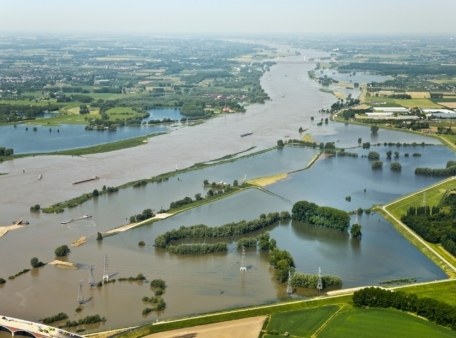
Flooding has become more common in the Netherlands in recent years. Therefore, southern safety regions want to be well prepared. Getting residents evacuated in a timely manner is a challenge, especially when conditions change by the hour. That is why MICD, TU Delft and Argaleo are developing an online tool to channel evacuations.
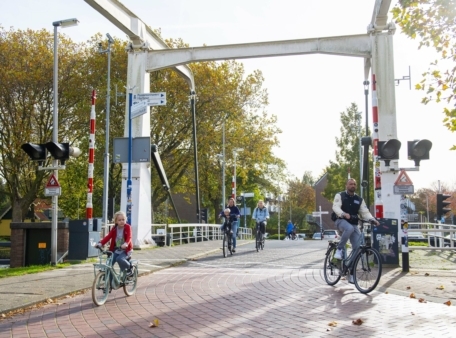
The large-scale, European research project MetaCCAZE focuses on the use of smart and green partial mobility and logistics. The aim is to find new and useful solutions that are also financially viable.
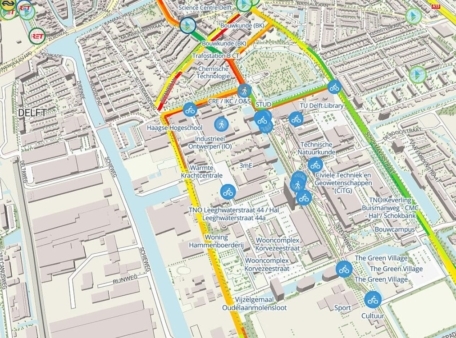
With the new TU Delft Outdoor Mobility Digital twin (OMDt) we are able to monitor and visualize all traffic on our campus, including pedestrians and cyclists. This helps us to take measures that not only benefit road safety, but also reduce crowding. MICD brought together nine partners, TU Delft labs and external partners, to work on this innovative solution.
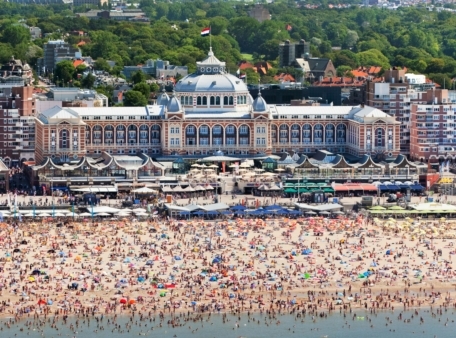
In the past, large groups of people all heading to the same beach or city centre have been somewhat of a headache for authorities. How can you guide large crowds to their destination without a hitch? And how do you manage all those people once they reach their destination? In the Crowd Safety Manager project, the municipality of The Hague is investigating whether predictive models can help to anticipate problems. The MICD is also participating in the project with a team of TU Delft researchers.
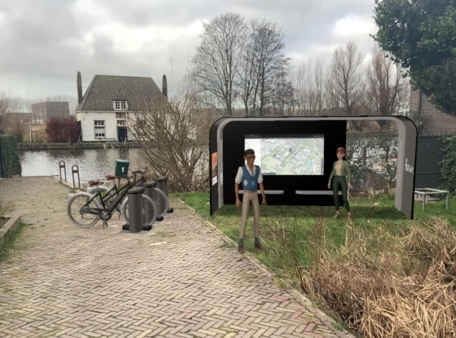
Smart mobility hubs are hot. They are seen as a promising instrument to keep (urban) areas accessible and liveable. But how do you design a good, future-proof smart mobility hub? In MICD’s Smart Mobility Hub pilot project, TU Delft researchers are harnessing the latest technologies to create the ideal hub that perfectly matches the mobility needs of an area.
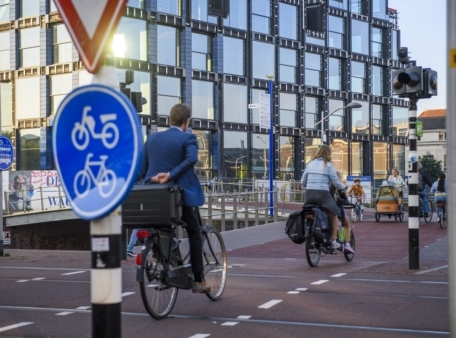
MICD, together with TU Delft, is launching a study on the conversion of cycling data into useful policy recommendations for governments. Based on large amounts of data collected by public authorities, analysts will assess the quality of the data, which trends they observe and how these insights may form the basis for the future design of cities.
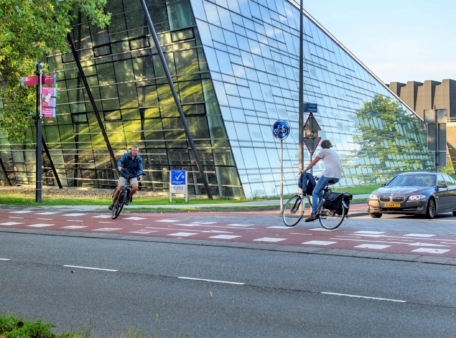
In many cities, a huge amount of data on traffic is collected every day. The greater the amount of data available, the more difficult it becomes to produce useful analyses. Within the European project Emeralds, useful tools are being developed for this purpose.