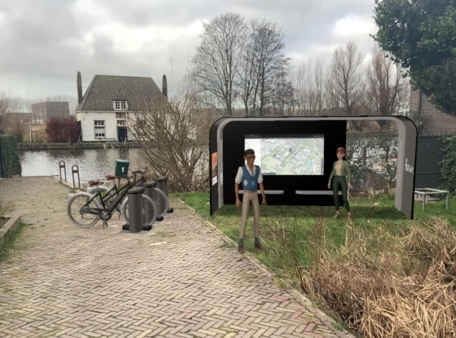
Walking to the nearest bus stop, navigating a station, changing trains—for people with disabilities, traveling by public transport can feel like an obstacle course. As a result, they travel less and participate less in society. This must and canchange, is the approach of the new NWO funded project BridgeXR.
The 34 public and private partners of BridgeXR identify obstacles and remove them, using eXtended Reality technology, Universal Design principles, and customized training programs.
Five Pathways
Therefore, BridgeXR defined five courses of action to make traveling more accessible and inclusive. These focus on understanding barriers, designing better infrastructure and signage, training people with disabilities, changing the way governments and transport operators work, and learning by doing in practical pilots.
To put ideas into practice, BridgeXR runs case studies in urban multi-modal travel, campus commuting, and trips to and from airports. These living labs highlight accessibility challenges, foster collaboration, and allow for innovative solutions to be tested, refined, and scaled.
Partners
The BridgeXR consortium is a diverse community of researchers, policymakers, transport providers, consultants, technologists, and advocacy groups. The partners are:
TU Delft, University of Groningen, Erasmus Medical Centre, HAN University of Applied Sciences, KiM Netherlands Institute for Transport Policy Analysis, SWOV, CROW, Ministry of Infrastructure and Water Management, Ministry of Health, Welfare, and Sport, Province of Zuid-Holland, Metropolitan Region Rotterdam The Hague, Amsterdam Regional Transport Authority, City of Amsterdam, City of Rotterdam, NS, ProRail, EBS, GVB, HTM, Rotterdam The Hague Airport, TU Delft Campus, Goudappel, Haskoning, Heijmans, Intergo, Sweco, Eyedog, Changefied, Dreamwaves, Ieder(in), Rijndam, Rover, Ruimte voor Lopen, Visio