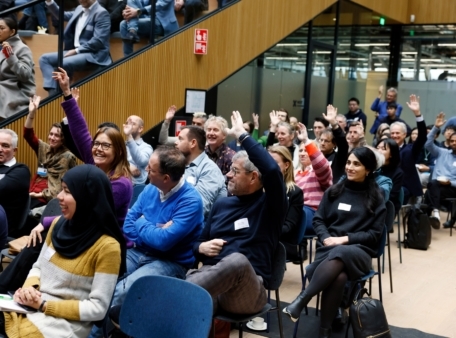
The course was held in two blocks: 2–3 October and 17–18 November. Participants received an intensive yet accessible introduction to the key functions of traffic management—such as traffic state estimation, short- and long-term prediction, anomaly detection, real-time control, and optimisation—and learned how modern AI methods can support these tasks.
Group Assignments
Through a mix of thematic lectures, hands-on data sessions, and collaborative group work, participants gained both theoretical understanding and practical insight into the role of AI in mobility. Real-world use cases, contributed by professionals, formed the basis for group assignments in which practitioners and PhD researchers worked together to address traffic challenges using AI-based approaches. During the period between the two course blocks, participants continued working on their assignments. On the final afternoon, they presented the results of their work.